what would be the first step to solve this system of equations by the substitution method?
A system of nonlinear equations is a system of two or more equations in two or more variables containing at least one equation that is not linear. Recall that a linear equation tin have the form [latex]Ax+By+C=0[/latex]. Any equation that cannot be written in this form in nonlinear. The exchange method nosotros used for linear systems is the same method we will use for nonlinear systems. We solve 1 equation for i variable and so substitute the upshot into the 2d equation to solve for another variable, and then on. There is, however, a variation in the possible outcomes.
Intersection of a Parabola and a Line
In that location are three possible types of solutions for a arrangement of nonlinear equations involving a parabola and a line.
A General Annotation: Possible Types of Solutions for Points of Intersection of a Parabola and a Line
Figure two illustrates possible solution sets for a arrangement of equations involving a parabola and a line.
- No solution. The line will never intersect the parabola.
- One solution. The line is tangent to the parabola and intersects the parabola at exactly one point.
- Two solutions. The line crosses on the inside of the parabola and intersects the parabola at two points.
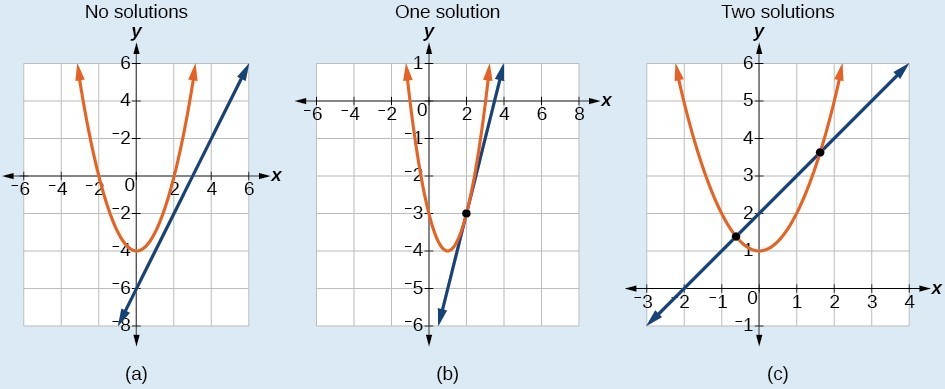
Effigy two
How To: Given a system of equations containing a line and a parabola, find the solution.
- Solve the linear equation for one of the variables.
- Substitute the expression obtained in step one into the parabola equation.
- Solve for the remaining variable.
- Bank check your solutions in both equations.
Example i: Solving a Organisation of Nonlinear Equations Representing a Parabola and a Line
Solve the organization of equations.
[latex]\begin{array}{50}x-y=-1\hfill \\ y={x}^{two}+1\hfill \end{array}[/latex]
Solution
Solve the showtime equation for [latex]ten[/latex] and then substitute the resulting expression into the 2d equation.
[latex]\brainstorm{array}{llll}x-y=-1\hfill & \hfill & \hfill & \hfill \\ \text{ }ten=y - 1\hfill & \hfill & \hfill & \text{Solve for }10.\hfill \\ \hfill & \hfill & \hfill & \hfill \\ \text{ }y={x}^{2}+ane\hfill & \hfill & \hfill & \hfill \\ \text{ }y={\left(y - 1\right)}^{ii}+1\hfill & \hfill & \hfill & \text{Substitute expression for }ten.\hfill \finish{array}[/latex]
Aggrandize the equation and set up it equal to zero.
[latex]\begin{array}{fifty}y={\left(y - one\correct)}^{2}\hfill \\ \text{ }=\left({y}^{2}-2y+one\right)+ane\hfill \\ \text{ }={y}^{2}-2y+2\hfill \\ 0={y}^{2}-3y+ii\hfill \\ \text{ }=\left(y - 2\right)\left(y - one\right)\hfill \stop{array}[/latex]
Solving for [latex]y[/latex] gives [latex]y=two[/latex] and [latex]y=1[/latex]. Next, substitute each value for [latex]y[/latex] into the get-go equation to solve for [latex]x[/latex]. Always substitute the value into the linear equation to check for inapplicable solutions.
[latex]\begin{array}{50}\text{ }10-y=-one\hfill \\ x-\left(2\right)=-one\hfill \\ \text{ }x=1\hfill \\ \hfill \\ x-\left(ane\right)=-ane\hfill \\ \text{ }x=0\hfill \end{array}[/latex]
The solutions are [latex]\left(ane,2\correct)[/latex] and [latex]\left(0,ane\right),\text{}[/latex] which tin can be verified by substituting these [latex]\left(10,y\right)[/latex] values into both of the original equations.
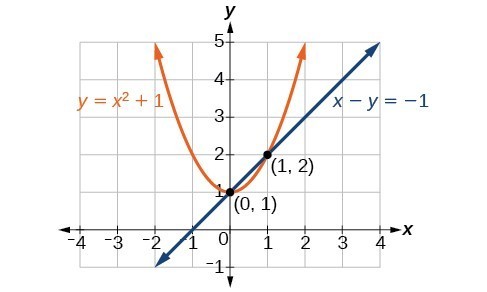
Figure iii
Q & A
Could we have substituted values for [latex]y[/latex] into the 2nd equation to solve for [latex]x[/latex] in Example 1?
Yep, but because [latex]ten[/latex] is squared in the second equation this could requite united states inapplicable solutions for [latex]10[/latex].
For [latex]y=1[/latex]
[latex]\begin{assortment}{50}y={x}^{ii}+1\hfill \\ y={x}^{2}+ane\hfill \\ {x}^{ii}=0\hfill \\ x=\pm \sqrt{0}=0\hfill \cease{array}[/latex]
This gives the states the same value equally in the solution.
For [latex]y=2[/latex]
[latex]\brainstorm{array}{l}y={x}^{ii}+1\hfill \\ 2={10}^{two}+one\hfill \\ {x}^{ii}=1\hfill \\ x=\pm \sqrt{1}=\pm 1\hfill \end{array}[/latex]
Find that [latex]-1[/latex] is an inapplicable solution.
Try It 1
Solve the given system of equations by exchange.
[latex]\begin{array}{50}3x-y=-2\hfill \\ 2{x}^{2}-y=0\hfill \end{assortment}[/latex]
Solution
Intersection of a Circle and a Line
Merely equally with a parabola and a line, in that location are three possible outcomes when solving a organisation of equations representing a circle and a line.
A General Annotation: Possible Types of Solutions for the Points of Intersection of a Circle and a Line
Figure 4 illustrates possible solution sets for a system of equations involving a circumvolve and a line.
- No solution. The line does non intersect the circle.
- Ane solution. The line is tangent to the circle and intersects the circle at exactly one point.
- 2 solutions. The line crosses the circle and intersects it at two points.
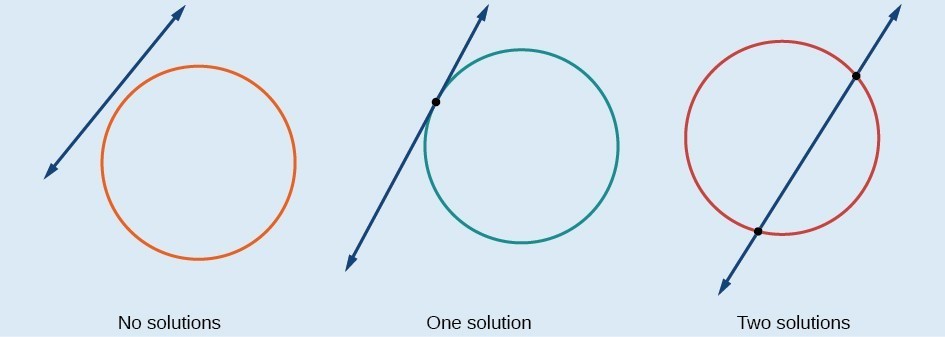
Figure 4
How To: Given a organization of equations containing a line and a circumvolve, find the solution.
- Solve the linear equation for one of the variables.
- Substitute the expression obtained in footstep 1 into the equation for the circle.
- Solve for the remaining variable.
- Check your solutions in both equations.
Example 2: Finding the Intersection of a Circle and a Line past Exchange
Notice the intersection of the given circle and the given line past substitution.
[latex]\begin{array}{l}{x}^{2}+{y}^{2}=5\hfill \\ y=3x - 5\hfill \end{assortment}[/latex]
Solution
Ane of the equations has already been solved for [latex]y[/latex]. We will substitute [latex]y=3x - v[/latex] into the equation for the circumvolve.
[latex]\begin{assortment}{c}{ten}^{2}+{\left(3x - 5\right)}^{ii}=5\\ {x}^{2}+9{x}^{2}-30x+25=5\\ 10{x}^{2}-30x+20=0\end{array}[/latex]
Now, we cistron and solve for [latex]ten[/latex].
[latex]\begin{array}{l}10\left({10}^{2}-3x+ii\right)=0\hfill \\ x\left(x - two\right)\left(x - 1\right)=0\hfill \\ 10=2\hfill \\ x=1\hfill \end{assortment}[/latex]
Substitute the 2 x-values into the original linear equation to solve for [latex]y[/latex].
[latex]\begin{assortment}{l}y=iii\left(2\right)-5\hfill \\ =i\hfill \\ y=iii\left(1\right)-v\hfill \\ =-2\hfill \end{assortment}[/latex]
The line intersects the circumvolve at [latex]\left(2,1\correct)[/latex] and [latex]\left(ane,-2\right)[/latex], which tin can be verified by substituting these [latex]\left(10,y\right)[/latex] values into both of the original equations.
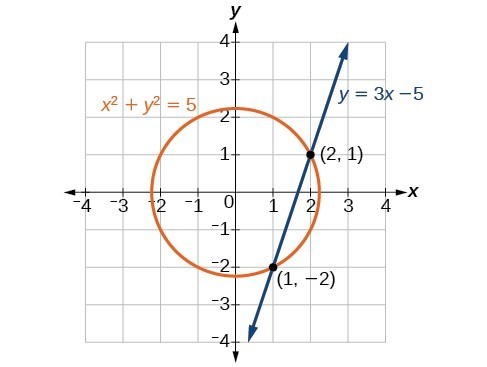
Figure v
Try Information technology two
Solve the system of nonlinear equations.
[latex]\begin{array}{l}{x}^{2}+{y}^{2}=10\hfill \\ ten - 3y=-10\hfill \end{array}[/latex]
Source: https://courses.lumenlearning.com/sanjacinto-atdcoursereview-collegealgebra-1/chapter/solving-a-system-of-nonlinear-equations-using-substitution/
0 Response to "what would be the first step to solve this system of equations by the substitution method?"
Post a Comment