Hearing a Story and Telling It Again as if You Know Its True

When you listen to a story, your brain waves really offset to synchronize with those of the storyteller. And reading a narrative activates brain regions involved in deciphering or imagining a person'south motives and perspective, research has found. aywan88/Getty Images hibernate caption
toggle explanation
aywan88/Getty Images
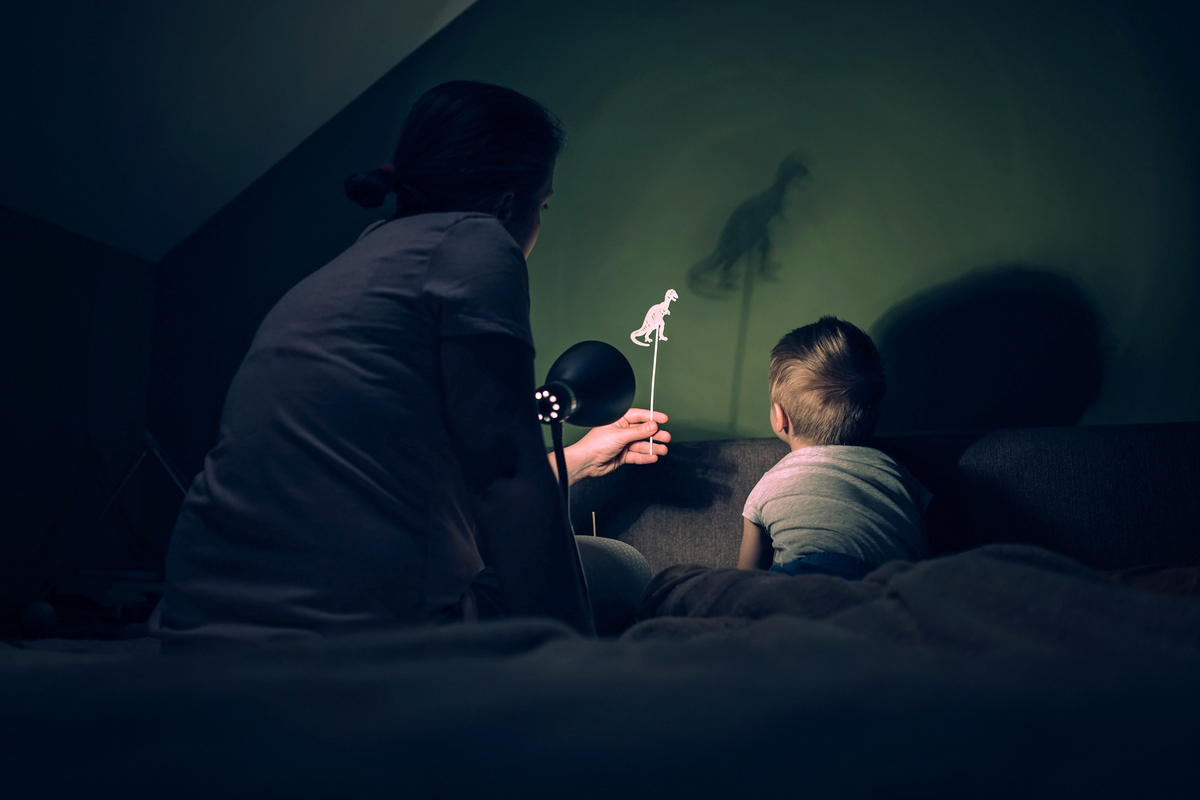
When you mind to a story, your encephalon waves really start to synchronize with those of the storyteller. And reading a narrative activates brain regions involved in deciphering or imagining a person's motives and perspective, research has found.
aywan88/Getty Images
When you heed to a story, whatsoever your age, you lot're transported mentally to another time and place — and who couldn't apply that right now?
"We all know this delicious feeling of existence swept into a story world," says Liz Neeley, who directs The Story Collider, a nonprofit production company that, in nonpandemic times, stages live events filled with personal stories nigh science. "You forget about your surround," she says, "and you're entirely immersed."
Depending on the story you lot're reading, watching or listening to, your palms may start to sweat, scientists find. Y'all'll blink faster, and your heart might flutter or skip. Your facial expressions shift, and the muscles above your eyebrows will react to the words — another sign that you're engaged.
A growing torso of brain science offers even more than insight into what'southward behind these experiences.
On functional MRI scans, many unlike areas of the brain low-cal up when someone is listening to a narrative, Neeley says — not merely the networks involved in language processing, simply other neural circuits, too. Ane written report of listeners establish that the brain networks that process emotions arising from sounds — along with areas involved in movement — were activated, especially during the emotional parts of the story.
As you hear a story unfold, your encephalon waves actually get-go to synchronize with those of the storyteller, says Uri Hasson, professor of psychology and neuroscience at Princeton University. When he and his research team recorded the brain action in two people as one person told a story and the other listened, they found that the greater the listener's comprehension, the more closely the brain wave patterns mirrored those of the storyteller.
Brain regions that do complex data processing seem to be engaged, Hasson explains: It's as though, "I'm trying to make your brain similar to mine in areas that really capture the meaning, the state of affairs, the schema — the context of the world."
Other scientists turned upward interesting activity in the parts of the brain engaged in making predictions. When we read, encephalon networks involved in deciphering — or imagining — some other person's motives, and the areas involved in guessing what will happen next are activated, Neeley says. Imagining what drives other people — which feeds into our predictions — helps u.s.a. see a state of affairs from different perspectives. Information technology can fifty-fifty shift our core beliefs, Neeley says, when nosotros "come back out of the story world into regular life."
Listeners, in turn, may keep thinking most the story and talk to others nearly information technology, she says, which reinforces the memory and, over time, tin drive a broader alter in attitudes.
Different formats of information — lists of facts, say, or charts — may be better suited to different situations, researchers say, but stories wield a peculiarly strong influence over our attitudes and behavior.
In health care contexts, for example, people are more likely to change their lifestyles when they encounter a graphic symbol they place with making the same change, notes Melanie Green, a communication professor at the University at Buffalo who studies the power of narrative, including in doctor-patient communication. Anecdotes tin brand health advice personally of import to a patient, she finds. When you lot hear or read about someone you place with who has taken up meditation, for example, you lot might be more likely to stick with information technology yourself.
Stories can alter broader attitudes besides, Green says — like our views on relationships, politics or the environment. Messages that feel like commands — even good advice coming from a friend — aren't always received well. If you feel like you lot're being pushed into a corner, you're more likely to push dorsum. Only if someone tells you a story about the time they, too, had to cease a painful relationship, for instance, the information will likely come across less like a lecture and more than like a personal truth.
Neeley has been taking advantage of these effects to shift perceptions well-nigh science and scientists in her work with Story Collider. "We try and take everybody — all unlike people and perspectives — put them onstage, and hear what a life in science is really like," she says.
Solid data in any form is good, Light-green says. "Merely that's not necessarily enough." A vivid, emotional story "can give that extra push to make it experience more existent or more important." If you await at the times somebody'south behavior have been changed, she says, it'south oftentimes because of a story that "hits them in the eye."
This story adjusted from an episode of NPR'southward weekday science podcast Short Wave.
Source: https://www.npr.org/sections/health-shots/2020/04/11/815573198/how-stories-connect-and-persuade-us-unleashing-the-brain-power-of-narrative
0 Response to "Hearing a Story and Telling It Again as if You Know Its True"
Post a Comment